

Childhood Vaccines: What They Are and Why Your Child Needs Them
 Kyle Bradford Jones, MD, FAAFP
In the past, many preventable diseases were common during childhood. Some diseases could result in significant illness, discomfort and even long-term disability or death. That’s why medical professionals introduced and developed a set of childhood vaccinations that guard against a wide range of viruses and bacteria.

Visit Our Interactive Symptom Checker
Choose a symptom and answer simple questions using our physician-reviewed Symptom Checker to find more information on your health issue.
Why childhood vaccinations are important
Vaccinating your child is one of the safest most effective ways to protect your child from illness. They are also cost-effective and almost all vaccines are covered by insurance, Medicare and Medicaid. A few reasons to vaccinate your child include:
- Vaccines prevent illness. Children are particularly vulnerable to disease. Vaccines help provide protection against a wide range of severe and even deadly illnesses.
- Vaccinating your child protects your community. The more people in a community are vaccinated, the less likely a disease is to exist. This is called herd immunity.
- Many childhood vaccinations are mandatory. Schools often have vaccine requirements, and some vaccines are required for travel to certain countries.
Childhood vaccination schedule (2026)
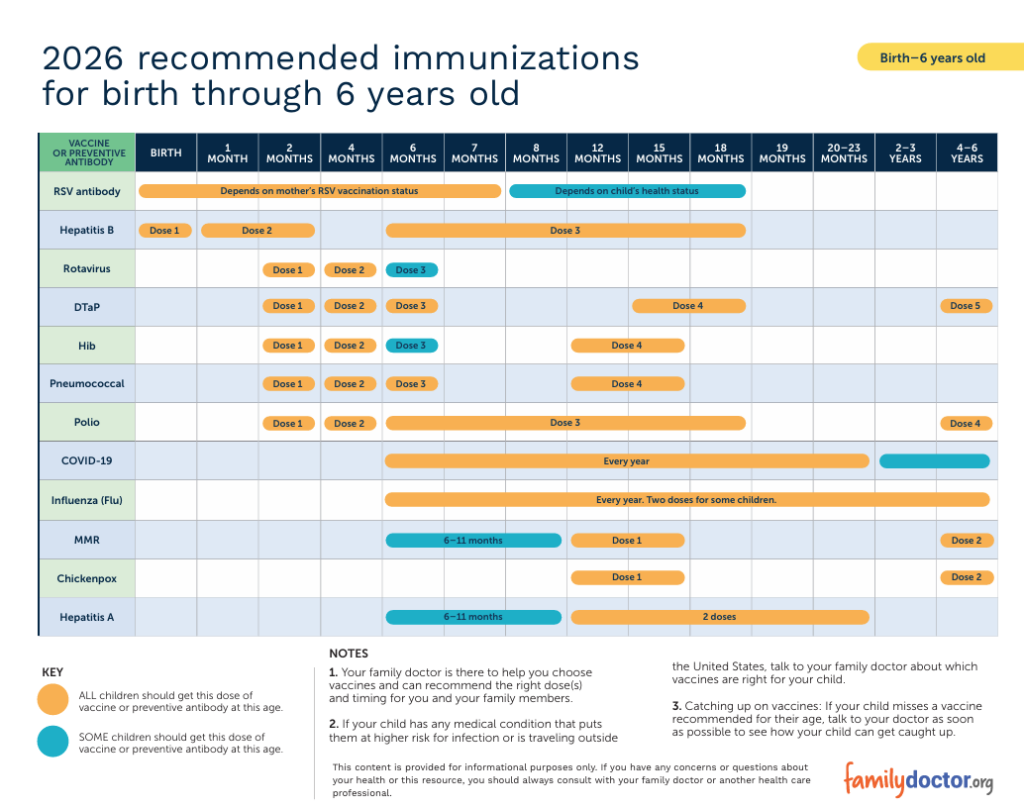
Children receive vaccines in line with recommendations called immunization schedules or vaccine schedules. These are reliable, trustworthy recommendations because they come from credible and independent experts.
The American Academy of Family Physicians (AAFP) provides an immunization schedule that you can discuss with your family doctor.
Vaccine schedule for children and adolescents (birth through 6 years)
Visit Our Interactive Symptom Checker
Choose a symptom and answer simple questions using our physician-reviewed Symptom Checker to find more information on your health issue.
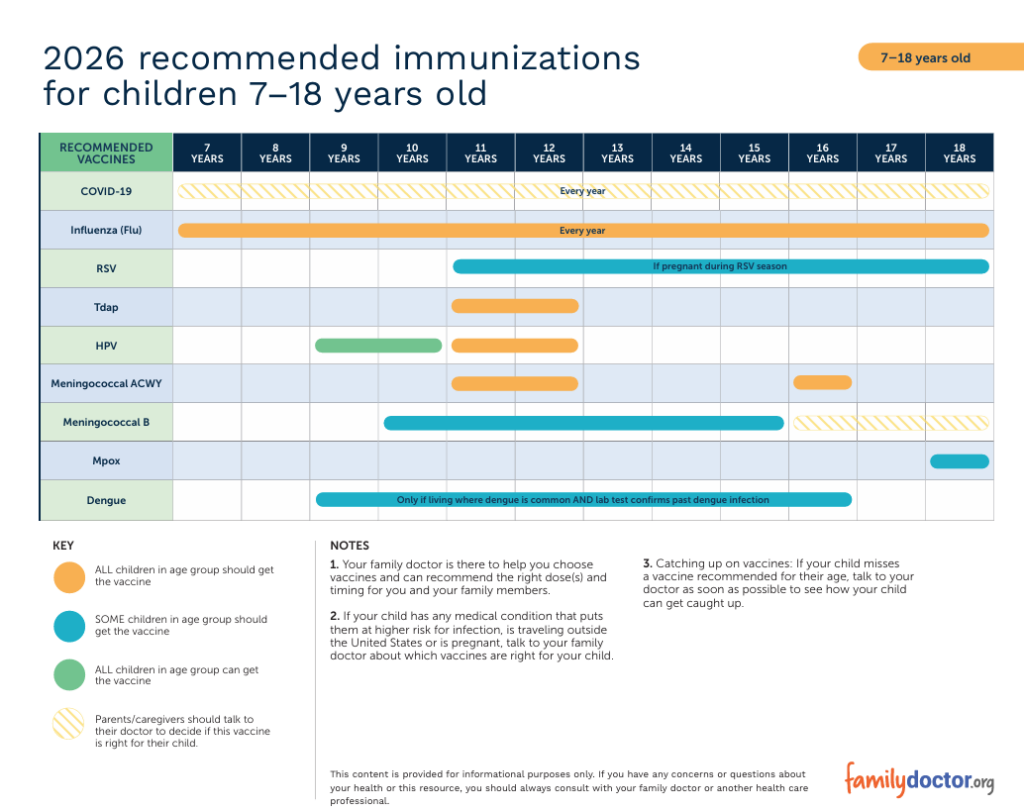
Vaccine schedule for children and adolescents (7 through 18 years)
What are the childhood vaccines?
Children and adolescents receive a variety of vaccines in their first few months and years of life. Here are the vaccines recommended by physicians and vaccine experts.
Hepatitis B vaccine
- What Hepatitis B is: Contagious viral infection of the liver spread through contact with infected body fluids such as blood
- When children should get the Hepatitis B vaccine: All children should get the first dose of the Hepatitis B vaccine at birth and second dose within two months.
Rotavirus vaccine
- What rotavirus is: Contagious viral infection of the stomach and intestines that spreads through contact with infected body fluids such as blood
- When children should get the rotavirus B vaccine: All children should get the first dose of the rotavirus vaccine at two months and the second dose at four months. For some children at additional risk, a third dose at six months can be recommended.
DTaP vaccine
- What Tdap is: Stands for diphtheria, tetanus and pertussis
- Diphtheria: Contagious bacterial infection of the nose and throat spread through air and direct contact
- Tetanus: Infection caused by bacterial spores found in soil and dust everywhere. Spores enter the body through wounds or broken skin.
- Pertussis: Contagious bacterial infection of the lungs and airways
- When children should get the DTaP vaccine: There are three doses of the DTaP vaccine that all children should get: one at two months, one at four months, and one at six months.
Hib vaccine
- What Hib is: Contagious bacterial infection of the lungs, brain and spinal cord, or bloodstream
- When children should get the Hib vaccine: All children should get the first dose of the Hib vaccine at two months and the second dose at four months. For some children at additional risk, a third dose at six months can be recommended.
Pneumococcal vaccine
- What pneumococcal is: Any infection caused by pneumococcus bacteria, from ear and sinus infections to infection of the lungs or bloodstream
- When children should get the pneumococcal vaccine: There are four doses of the pneumococcal vaccine that all children should get: one at two months, one at four months, and one at six months. The fourth dose should be given between 12 and 15 months.
Polio vaccine
- What polio is: Contagious viral infection of nerves and brain; spread through the mouth, air and direct contact
- When children should get the polio vaccine: All children should receive four doses of the polio vaccine. The first dose should be at two months and the second dose should be at four months. The third dose can be given between six and 18 months. Finally, the fourth and final dose should be given between four and six years of age.
COVID-19 vaccine
- What COVID is: Contagious viral infection of the nose, throat or lungs; may feel like a cold or flu
- When children should get the COVID vaccine: All children between six months and two years of age should get the COVID vaccine each year. Children and adolescents between two and 18 years of age can receive the COVID vaccine every year after determining what’s best with your family physician.
Influenza (flu) vaccine
- What the flu is: Contagious viral infection of the nose, throat and sometimes lungs
- When children should get the flu vaccine: All children should get the flu vaccine every year starting at six months of age. Some children under the age of seven years should get two doses.
Chickenpox (varicella) vaccine
- What chickenpox is: Contagious viral infection that causes fever, headache and an itchy, blistering rash
- When children should get the chickenpox vaccine: All children should get two doses of the chickenpox vaccine. The first dose should happen between 12 and 15 months. The second dose should happen between four and six years.
Hepatitis A vaccine
- What Hepatitis A is: Contagious viral infection of the liver spread by contaminated food or drink or close contact with an infected person
- When children should get the Hepatitis A vaccine: All children should receive two doses of the Hepatitis A vaccine between ages 12 months and 23 months. Some children at higher risk should get a dose of the vaccine as early as six months.
Meningococcal ACWY
- What meningococcal ACWY is: A type of contagious bacterial infection of the lining of the brain and spinal cord or the bloodstream; spread through air and direct contact
- When children should get the meningococcal vaccine: All children should get the first dose of the meningococcal vaccine between ages 11 to 12 years. Children should also get a second dose at age 16.
Common childhood vaccination myths
Parents want the best for their children and want them to be healthy. Unfortunately, there is a lot of vaccine misinformation out there. While making healthcare decisions about your child is a personal choice, it’s important to be aware of common vaccine myths and misinformation.
- Childhood vaccinations do not cause autism. There are no credible studies that link vaccinations and autism.
- Childhood vaccinations do not overload the immune system. Children are exposed to significantly more germs every day than they are during the entire vaccination series.
- Childhood vaccines do not cause disease. Sometimes a vaccinated child will get symptoms similar to the disease they’re getting vaccinated for a short time. This is a normal part of the immunization process.
Questions to ask your doctor
- Can my child have an allergic reaction after a vaccine?
- If my child missed a vaccination, is it possible for them to catch up?
- How do I get my childhood vaccination records?
ADVERTISEMENT
ADVERTISEMENT
Related Articles